Three different things that are often confused
Sensory experience includes what someone sees, hears, touches and feels while moving. Fine motor skills concern coordinated hand and finger actions. Art therapy involves a psychological purpose and a professional relationship. One activity may contain all these elements, but they are not synonyms. Folding a paper house involves touching paper, coordinating hands and imagining a story. That does not automatically make it treatment. Families gain more from asking which particular action is difficult or interesting than from looking for a universal toy advertised as developing the brain.
Look at an everyday action, not an abstract score
Children’s occupational therapy services focus on participation in everyday activities. A practical concern might be difficulty opening a pencil case, holding paper while cutting or using a spoon. Break the activity into components: can the child sit comfortably, reach, hold the object and use the other hand? This is not a home diagnostic test; it helps describe a difficulty more accurately to a professional. Replacing a slippery box with a stable one may improve access without training determination. Assess comfort and independence in an activity that matters to the child, rather than minutes spent enduring a task.
Adjust difficulty and preserve choice
Start with an action the child can partly manage already: tearing large paper pieces, pressing a broad stamp or folding wide cardboard strips. Change one feature at a time, such as size, instead of changing speed, accuracy and rules simultaneously. These are editorial examples of organising play, not developmental standards. An activity that is too easy may be uninteresting, while an overly difficult one may offer only repeated failure. Offer a choice between two accessible options. Another child of the same age may choose differently: interests and skills do not develop at identical rates.
Sensory preferences do not need defeating
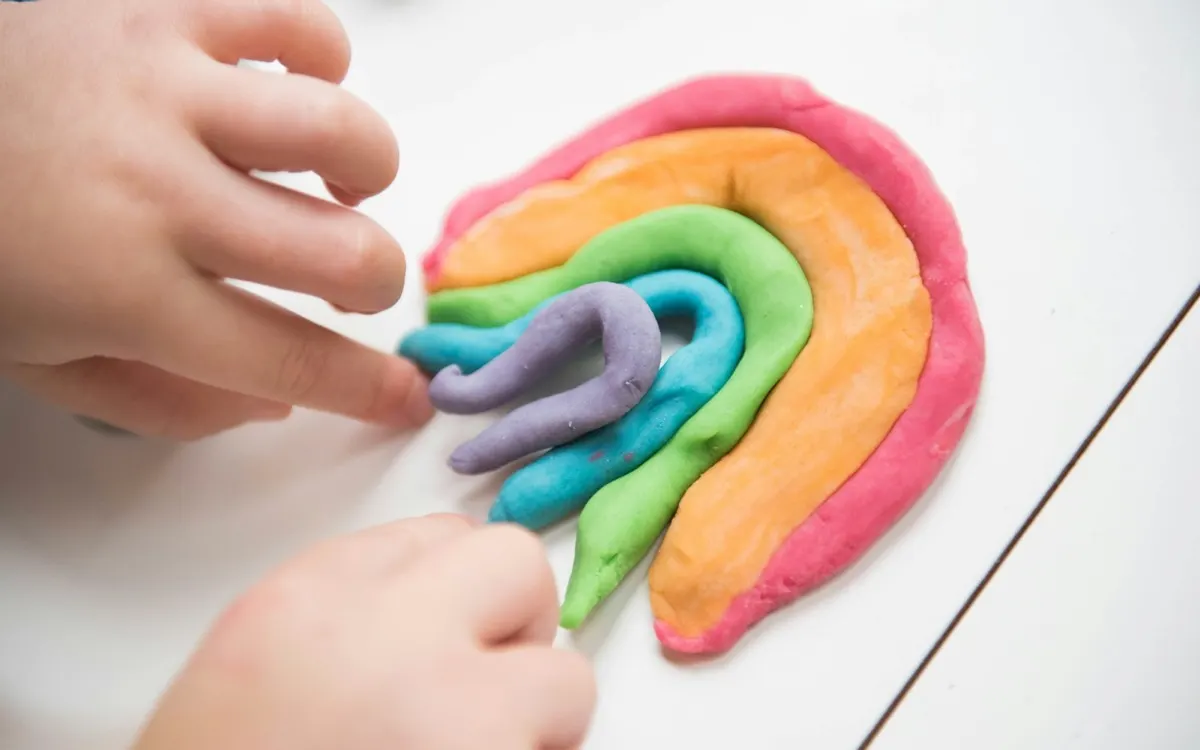
Some people enjoy soft dough; others dislike sticky hands. One child enjoys rustling sounds while another asks for quiet. Preferring pencils to finger paint does not itself establish a diagnosis. Offer a tool, dry materials or distance from an unpleasant texture. Do not hold a child’s hands in a substance or treat refusal as a moral failing. If sounds, touch or movement substantially interfere with dressing, eating or attending school, discuss this with a paediatrician or relevant professional. The concern is difficulty participating, not an obligation to enjoy every possible sensation.
Why “sensory therapy” requires a more precise explanation
Everyday texture play is not equivalent to a defined professional intervention. An AAP educational page updated in 2019 describes the limited and inconclusive evidence available then for sensory integration in autism. It is a dated source, not a summary of all current research. Before paying for a programme, ask for its exact name, the practitioner’s qualifications, evidence relevant to your concern and a plan for reviewing outcomes. Do not generalise a conclusion about one method to all games or children. Promising to reset the nervous system without a clear purpose and evaluation does not support informed decisions.
Material safety matters more than an attractive video
Choose component sizes, labelling and supervision with age and mouthing behaviour in mind. CPSC warns against water beads in environments with children because swallowing them and their expansion inside the body can cause serious harm. They are unnecessary for a home collection of activities. Wooden objects also need checking: cracks, splinters, detachable small pieces and finishes matter more than the word natural. Do not copy an activity simply because it looks peaceful in a photograph. An adult craft material may be unsuitable for children; supervision does not make an inappropriate product safe.
An example with several ways to participate
Imagine a post office made from a large box and cardboard letters. One child posts prepared letters through a wide opening. Another decorates them, while a third folds envelopes with adult help. This is not a test of who is more developed: participants have different roles within one story. If letters get stuck, first change the opening or cardboard thickness. If a hand becomes tired, inventing addresses aloud can become part of the game. The example shows how to adapt an environment instead of demanding identical motor actions from everyone. Stopping or switching games is also acceptable.
What to record before a consultation or purchase
A useful note includes the specific action, conditions, frequency of difficulty and support already tried: “Holds the paper, but scissors quickly tire the hand; larger sheets are easier.” Pain, loss of previously acquired skills or substantial everyday difficulties warrant professional assessment. When choosing a product, check dimensions, materials, care instructions, intended use and warnings. Do not expect a demonstrated treatment effect from something sold as an ordinary play material. A useful purchase fits the family’s actual activities; its value does not depend on the number of psychological terms in its description.