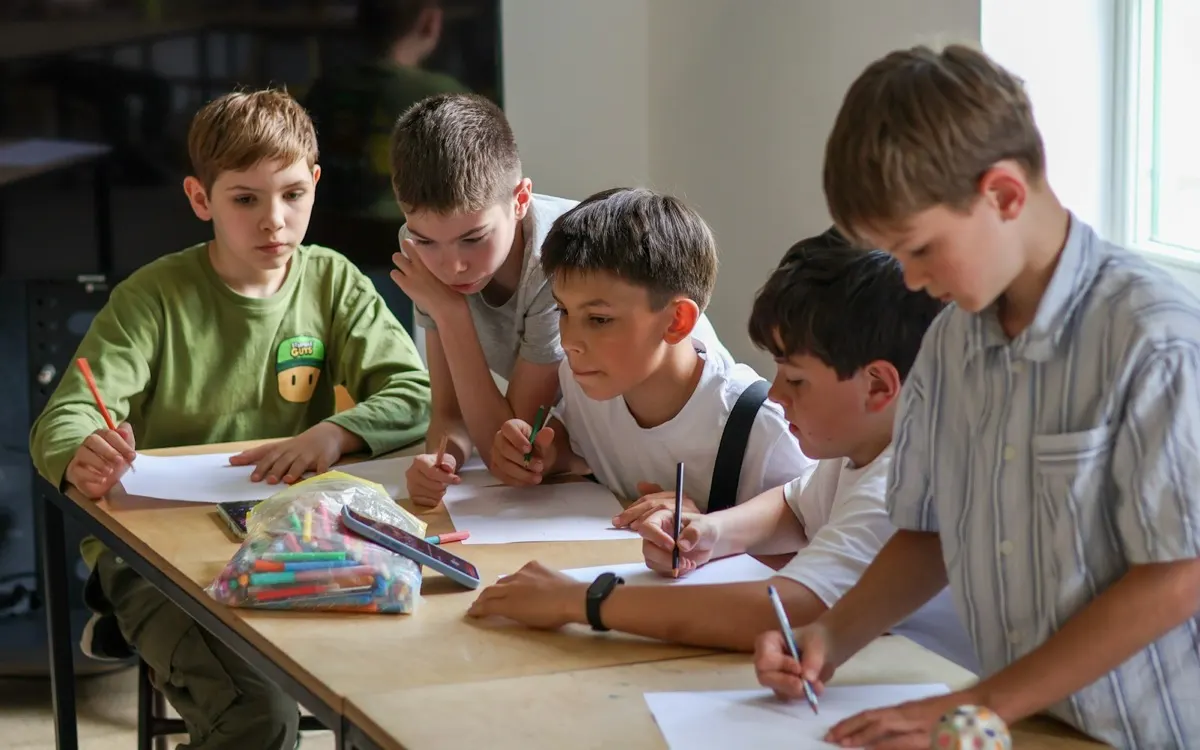
School as a place of support
School art therapy is professional support in an educational setting, rather than a special art lesson. AATA describes schools as an important access point, including when families find other services difficult to reach. Proximity alone does not establish suitability for every child. First ask who leads sessions, what training they have and how need is assessed. An invitation should not sound like punishment for behaviour or a message that a child's creativity is wrong. Explain the purpose clearly and welcome questions.
Separate therapy from the lesson
An art class may teach composition, technique or materials. A therapeutic service concerns psychological support; artwork is not an assignment to grade. In an invented example, a pupil worries that a drawing will be shown to the teacher and marked. Clarify who sees it and why. If one staff member has several roles, ask when they act as teacher and when as therapist. A job title alone cannot resolve mixed expectations, authority or information access. Clear boundaries help families and children understand what kind of meeting they are attending.
Two ways to fit the school day
AATA describes support within classrooms and separate meetings outside the current lesson. Both require practical agreements. Imagine a pupil always missing their favourite subject: even a useful service could become associated with losing something important. Ask how timing is chosen, whether it can change and how missed work is handled without extra pressure. Classroom work needs a separate privacy discussion. Everyone having paper does not mean everyone should hear or see a child's personal story. The timetable and room arrangement are part of the service, not merely administrative details.
Whose concern guides the work?
Parents may want fewer conflicts, a teacher calmer participation and a child an end to teasing. These concerns connect but are not identical. Request a shared goal that includes the pupil's experience rather than adults' convenience alone. “Knowing whom to ask when things are difficult” is more concrete than “becoming obedient.” This is an invented goal example, not a ready-made programme. Ask how the child can disagree or report that sessions do not suit them without fearing the loss of a teacher's approval or access to other support.
The team and information boundaries
Parents, psychologists, teachers and other specialists may collaborate. Agree what each receives: general support suggestions, attendance information or details of personal conversations. Do not assume the entire teaching staff automatically forms one confidential care team. Ask about consent, safeguarding and record access under local rules. Artwork does not become material for a school exhibition simply because it was made at school. Public display requires a separate discussion, including the possibility of refusal. A general wish to celebrate children's creativity does not remove the need to respect personal material.
Access begins before the activity
Consider the route, corridor noise, table height, communication and predictable transitions. UNICEF approaches inclusive education through barriers to participation; this is also a useful framework for questions about additional services. In an invented example, a child avoids a room because a loud bell is nearby, while adults interpret this as unwillingness to cooperate. Discuss the environment first. Accessibility is not providing everybody with an identical materials kit: different supports may create a more equal chance to participate. Ask the pupil what makes entering and using the space easier.
Holidays, transitions and endings
School years contain breaks, timetable changes and movement between classes. Ask how children prepare for holidays, a new practitioner or the end of a course. Imagine a pupil learning only at the day's end that it was their final meeting; earlier explanation could make the situation more predictable. Clarify who is available during breaks and where other help can be accessed. A school programme may not cover every family need, so it is useful to understand external referral routes before difficulties arise rather than assuming support continues unchanged throughout the year.
What to review
Discuss participation, the child's own feedback, learning demands and agreed goals. More attractive pictures or greater obedience do not by themselves demonstrate psychological benefit. Ask for specific observations without diagnosing through colour or subject matter. A practical review can answer three questions: what helps, what creates barriers and what changes next? AATA's American examples show possible models, but do not automatically define staff roles, rights or service arrangements in Ukrainian schools. The local agreement should explain actual responsibilities instead of relying on a foreign programme's name.