A room's name does not reveal its agreements
Group art therapy means psychological work in a group format; an open studio describes an organisation of creative space that can exist in different settings. Finkel and Bat Or's review identifies varied clinical and non-clinical studio models. Ask about the programme's actual purpose, not only its title. A shared table, paints and friendly atmosphere can look similar while agreements about care, participation and responsibility differ.
Open can mean several things
A studio may permit free material choices while keeping a stable membership. Another may allow people to arrive during set hours without attending an entire series. The review describes such variation; the word open does not resolve it. Before visiting, ask whether booking is required, who may join, how introductions work and whether unfinished pieces can stay. These are practical conditions, not a ranking of depth or usefulness.
Working alongside and making together
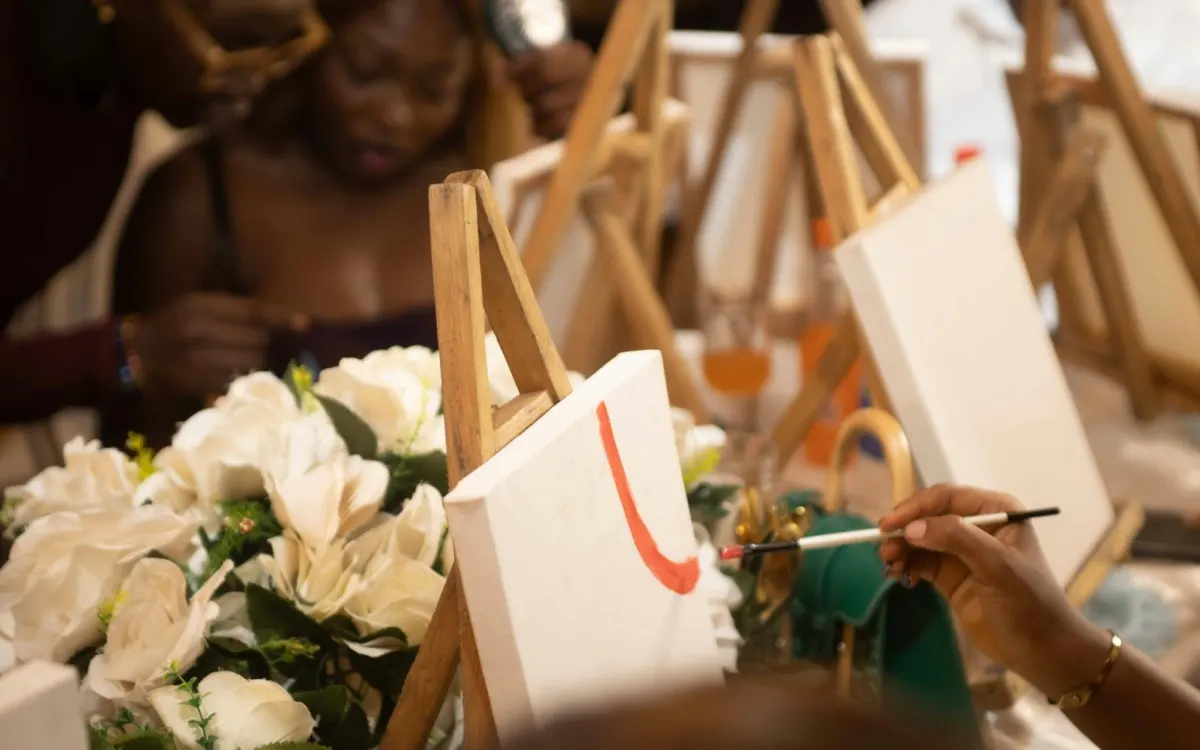
In one invented example, each adolescent makes a separate collage at a shared table. In another, the group builds one paper town. Shared materials do not require shared authorship. The town needs agreements about changing existing parts; separate collages require arrangements for supplies and personal space. Quiet individual work should not automatically count as non-participation. Being in the same room does not identify which interaction someone has chosen today.
Conversation can be an invitation
Tipple and Brown's open-group description emphasises quiet work without compulsory interaction. Our practical example distinguishes “you may show it” from “everyone must explain now”. If discussion is part of a programme, participants should know beforehand. Different levels can be agreed: naming a material, saying a few words or passing. Structure then becomes understandable without automatically treating silence as a hidden problem or unwillingness to cooperate.
Group agreements as concrete actions
BAAT's guidance for a specific clinical context discusses shared boundaries supporting participation. For an educational comparison, translate respect into actions: ask before photographing, do not touch someone else's work and speak from your perspective. “This colour brings back a memory for me” differs from “your colour means fear”. Rules can reduce misunderstandings but cannot guarantee confidentiality among all members. Explain that limitation honestly. A group agreement is a shared expectation and a way to address breaches, not proof that no participant could ever repeat something outside the room.
Do not guess the facilitator's role
A facilitator may support materials, organise discussion or create alongside participants depending on the model. Ask what their role is here. In our example, two people want the same large sheet. First resolve the resource problem through another sheet, division or turns. Every disagreement does not require public psychological analysis. If interaction belongs to agreed therapeutic work, a practitioner may invite discussion while keeping the practical problem distinct from a broader hypothesis.
Community and an individual creative voice
Denise Malis examines a studio programme through community and creative agency. Readers can ask whether there is room for their idea, opportunities to learn from others and freedom from competition. Imagine a teenage newcomer seeing a neighbour's complex work. The facilitator can explain available materials without requiring a matching result. Sharing space with different experience levels does not oblige everyone to work alike or display the same emotions. The educational question is what conditions permit genuine participation, not whether every creation looks equally accomplished or communicates the same story.
Exhibiting is a separate agreement
An exhibition may be welcome but should not be an automatic ending. Clarify viewers, names, photographs and online publication. Someone may show one part while keeping another private. One participant's permission does not decide for everyone who made a shared composition. Parents should hear children's preferences rather than judge only the attractive result. The confidentiality chapter develops these choices. Agreement about joining an activity and agreement about making its products public are different decisions, even when organisers regard a final display as a celebration.
Choosing a format and reading evidence
Compare purpose, participation, facilitator qualifications, accessibility and endings. When evaluating research, establish whether it concerns a clinical group, community studio or short workshop. A result in one cannot automatically transfer to another. This chapter's invented examples explain organisation rather than establish effectiveness. If seeking psychological care, ask how the group addresses your concern. If seeking shared creativity, a clearly described non-clinical studio may also be suitable. Clear distinctions expand meaningful options rather than implying that every valuable creative encounter must become a clinical service.